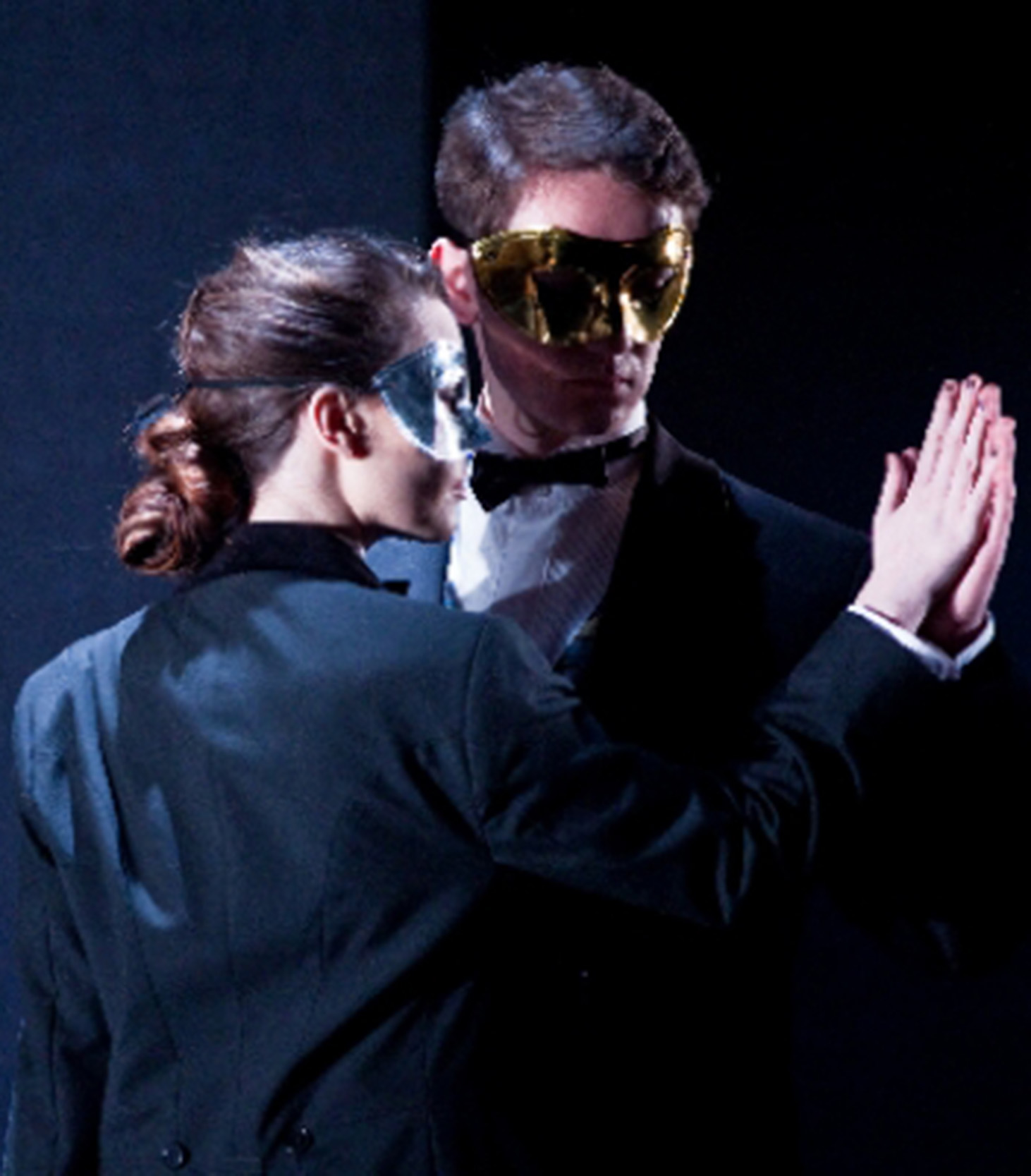
All 7500 tickets to this year's Trintiy Ball were booked by 1pm today, after registration opened at 9am.
Registration is now closed, meaning that only those who have already requested tickets will be able to purchase them. All existing registrants will now be allocated tickets upon payment on a first-come, first-served basis. Registration does not guarantee a ticket until it has been paid for.
Queues this morning were among the longest seen for the Ball in years, wrapping around front square past the Public Theatre despite consistent rain. The allocation of tickets which could be paid for online via PayPal were quickly exhausted, leaving students with the options of attempting to contact the busy credit card hotline or joining the ranks queuing outside the Students' Union Shop.
This year's lineup includes Dizzee Rascal, Mr Hudson, Digitalism and Jape. You can find out more about the Ball and listen to the artists here.
The annual Trinity News Ball Guide is now available below, featuring the full lineup, band profiles, interviews, selected listening, and much more.
From the headliner, Dizzee Rascal, right down to the up-and-comers like Example and Ou Est Le Swimming Pool, we have all you need to know.
We've also compiled a playlist of essential tracks right here so you can get a taste of each artist. Just click play on the right- you can even leave it running while browsing the Ball Guide fullscreen.
Ball tickets are on sale from February 24, priced €78.See www.trinityball.ie for more details.
There was much buzz in the press last week about Channel 4’s Sunday night drama, Mo. The portrayal of the late Northern Ireland secretary Mo Mowlam and her incendiary brand of politics was a great success for the broadcaster, earning them their highest drama viewing figures in almost a decade. Many critics already even believe that Julie Walters already has next year’s television awards season wrapped up with her powerhouse performance in the title role. Heralding the show’s broadcast was a new slew of facts about Mowlam’s life, exposing the real extent of the firebrand politician’s brain tumour. It appears that the wily MP had known even before New Labour got into power about her malignant cancer, but had decided, against leading cancer specialist Mark Glazer’s advice, to not only contest the pivotal 1997 election, but also to take up the high-pressure Northern Ireland portfolio. Claiming that her fatal affliction was no more than a benevolent tumour, Mowlam racked up a series of successes during her spell at Stormont, not least her stewardship of the historic Good Friday Agreement. However the revelation does prompt some questions regarding Mowlam’s accountability. With a life expectancy of only three years—she lived a further nine until she died in 2005—Mowlam was heavily discouraged from continuing on with her career by her doctor, acutely aware of how seriously this form of cancer could affect the cabinet member’s cogitation and reasoning abilities. In light of these disclosures, many have attributed the magnitude of Mowlam’s achievements to her canny awareness of the time constraints inflicted by her illness. But there will never be any consensus as to whether this was the brave act of a human being, sensitive to the possibilities afforded her by her indubitable political talent, or the reckless behaviour of a self-aggrandising operator, career-driven to the end. The first image is of course preferable, but there’s little that can make that niggling doubt go away about just how irresponsible her activities were. The issue also highlights the growing trend of media obsession with a politician’s bill of health. It seems bizarre that the gravity of Mowlam’s situation, given her high-profile position, could have been so expertly concealed just over ten years ago. In 2008’s US presidential election, a frequent jibe used against John McCain was his illness ridden past, despite the fact that he provided comprehensive doctors’ reports at various stages of the campaign trail. Gordon Brown is consistently dogged by claims that he has gone blind, though it may be metaphorically fair to say he has lost his vision. It is ironic that so much of the ongoing fight over US healthcare seems to pivot on the former seat of Teddy Kennedy, whose own fatal struggle with a brain tumour made the drama surrounding the controversial bill so much more poignant. The current hype surrounding full disclosure of medical history creates a stark contrast to a bygone era where figures like John F. Kennedy (afflicted by crippling back-pain), Eamonn de Valera (almost totally blind by the time he ended his long reign as Taoiseach) and Winston Churchill (who left 10 Downing Street after suffering his second stroke) led their countries through periods of great turmoil, with the public none the wiser. However there have been some recent rumblings of a backlash from a jaded public. On St. Stephens Day at the end of last year, a 5.30 breaking news bulletin went out on TV3, in a desperate attempt to be the first to break the story of Minister for Finance Brian Lenihan’s pancreatic cancer. The next day, the channel was widely panned for its action, branded as opportunistic and heartless for its intrusive behaviour at such a sensitive time of year. This viewpoint on the story offered other Irish news outlets a way of discussing the Minister’s illness under the guise of a critique of TV3, a highly fortuitous scenario for the likes of RTE and The Irish Times amongst others. But this chain of events did elicit large amounts of sympathy for the politician, already one of the most popular members of the Irish government, from a public who were swift to register their disgust at TV3’s behaviour. A recent Sunday Independent opinion poll found that 70% of people supported the minister’s decision to stay in office, proving that, like in the case of Mo Mowlam, the correlation between a politician’s health and their performance in the job may be more slight than the media would want us to believe.
The acclaimed author has relaunched the euthanasia debate with a recent BBC lecture.
Among all the mysteries of neurology, there’s an old argument that an active brain is the best defence in protecting oneself from diseases of the mind. However, when bestselling author, Sir Terry Pratchett, was diagnosed with a rare form of Alzheimer’s disease in December 2007, this belief was certainly challenged. As renowned author of the Discworld series, Pratchett’s imagination is what has made him so successful. A year after his diagnosis, Pratchett received an honorary Doctorate of Literature from Trinity College Dublin--significant, not least due to the fact that it was the first that he had been awarded by a university founded before the 20th century. Pratchett’s involvement with the issues of euthanasia fully began in an article published in mid 2009, sparking widespread discussion. He said that he wished to commit “assisted suicide” (though he prefers the term “assisted death”) before the Alzheimer’s disease progresses to a critical point. This statement triggered an international debate on euthanasia. Last week, Terry Prachett had the honour of being the first novelist to give the Richard Dimbleby Lecture, which he entitled “shaking hands with death”. In it he explored with striking humility and a subtle humour how modern society needs to redefine how it deals with death. Pratchett made the case for euthanasia tribunals which are “some kind of strictly non-aggressive tribunal that would establish the facts of the case well before the assisted death takes place”. These tribunals have been given the label “death panels” by those who find the idea morally repugnant. In this debate, opponents of assisted death always argue that man should not “play God”. Terry Pratchett says, “the problem with the God argument is that it only works if you believe in God”. His response effectively captures the gulf that exists between the opposing camps, and the prospect of moving forward with the issue seems remote. However, Pratchett’s view is supported by two recent UK polls (one BBC Panorama and one YouGov survey) in which over 70% of respondents believed that a change in the law was necessary, in order to allow some form of euthanasia. Pratchett says, “If I knew that I could die at anytime I wanted, then suddenly every day would be as precious as a million pounds. If I knew that I could die, I would live. My life, my death, my choice”. It is on this poignant note he ended the lecture, and we should take note. Pratchett has used his personal plight and public profile usefully, enabling a discussion that we all need to have.
A film by Bollywood director Sanjay Sharma entitled Dunno Y ... Na Jaane Kyun is giving India’s movie-going public its first on-screen gay kiss. This comes after a High Court ruling last year legalising homosexuality. The film’s plot explores an overtly sexual relationship between a struggling male actor and the man he finds on the way to claiming fame and fortune in the movie industry. Film posters bear the image of two naked young men locked in a passionate embrace. Though the High Court ruling is a significant step forward for India’s gay rights movement, the legislation still must pass through the Supreme Court. Homosexuality remains a taboo within Indian culture. Nevertheless, when the film is released in May, it will stand as a popular culture representation of a remarkably liberal shift in India’s public opinion and politics. Dunno Y … Na Jaane Kyun, or “Don’t Know Why”, is the first film in India’s history to treat homosexuality seriously. In another recent Bollywood film, Dostana, the two male characters must pretend to be in a gay relationship, but only to convince their landlord to allow his beautiful daughter to live with them. Most other portrayals of homosexuality in Indian film have similarly been as stereotypes used for comic relief. Of course, Sharma’s film is garnering a significant amount of attention. But the filmmaker seems to be taking it easy. “At the moment I’m not thinking about any political or censor problems”, Sharma told the BBC. Gay rights activists have praised the film’s audacity in tackling its subject seriously, and believe it will lead to an even more free and open environment for gays in India. Sharma seems not to be thinking of the film as a political statement—or is at least playing this aspect down to avoid any problems. “The only thing I was particular about was that this character should not come across as a caricature or just as an object of mockery. I am truly happy with what I have chosen”, Sharma told the Times of India. The film’s lead is Sharma’s brother Kapil, who is pursuing his role alongside the more established Bollywood stars of Zeenat Aman, Helen and Kabir Bedi. The involvement of some of Bollywood’s higher-profile actors has already added to the potential impact of the work through giving their explicit affirmation of the film. This is significant since Bollywood actors have huge followings. All of this clearly draws comparisons to Ang Lee’s 2005 film Brokeback Mountain, in which Jake Gyllenhaal and Heath Ledger play rough-looking cowboys whose homosexual relationship belied stereotype. So, for Mr. Sharma, the next few months should be exciting. It looks as if India is making more progressive steps toward a free and tolerant state than most others. However, the question remains, when will a gay kiss cease entirely to be shocking?
Haiti’s earthquake was just one of three major natural disasters in the past decade, yet it has provoked the greatest charitable response.
Three weeks after Haiti’s capital, Port-au-Prince, was struck by the country’s most severe earthquake in over 200 years, we’ve seen the repercussions—both here and abroad. We’ve walked by schoolchildren asking for donations on Grafton Street; we’ve seen John Travolta fly in on his private jet to help with the recovery efforts; we’ve made every party a Haiti benefit as internationally-renowned celebrities organized one of their own. We have seen, on the national and international media, images of bodies littering the ground and stacked along roadways, watched news anchors break down in front of millions of viewers as they talk about now-childless mothers. The images circulated by global mass media are difficult to turn away from, and they’re not altogether unfamiliar. After all, a tsunami hit the Indian ocean five short years ago, and Hurricane Katrina ravaged New Orleans, Louisiana, six months later. In both catastrophes, we saw similar wreckage to the images that we see now: portraits of people who ordinarily live on the edge of poverty with their homes destroyed and their families missing. These widely circulated depictions of human misery have become familiar to us, thanks to 24-hour-news and websites with hourly updates. But something seems different this time: it seems that Haiti is receiving more global charity and attention than either Katrina or the tsunami, and we’re left asking why. After all, the death toll in Haiti is still smaller than that of the tsunami by almost 100,000. The world economy is struggling, in comparison to robust 2004 and 2005. What is it that makes us want to give more now than we did then? And what can we learn about our global community from the differences in our reactions to each disaster? Perhaps the easiest answer relies on an assessment of international politics. Though many of the victims of Katrina left in New Orleans were destitute, Katrina nevertheless took place in the richest country in the world. It’s assumed that the United States can take care of itself, and it did, raising $580 million in charitable aid in the eight days after the disaster. Katrina elicited less global attention because it seemed to be concentrated in its own hemisphere, with its own powerful government left to deal with the fallout. Haiti, unlike Indonesia, is close enough to the U.S. geographically to garner American sympathy and attention, with the U.S. raising $305 million for Haiti in eight days as opposed to $163 million for the tsunami. And Americans are not unique in their ties to Haiti: as a former French colony, Haiti’s ties to the EU run deep. Perhaps there is a sense of European guilt for the legacy of colonialism in a country that had an underdeveloped economy and faltering political structures before being hit by catastrophe. Though Haiti is located in the U.S.’s sphere of influence, its ties to the EU imply a vast (and global) net of international relationships—a net not as strongly woven in Indonesia and the other South Asian countries affected by the tsunami. Or perhaps the influx of charity has to do with the concentration of the Haitian earthquake. Though the death toll from the tsunami was higher, it was more spread out. Haiti’s catastrophe affected the entire livelihood of one country in particular. Perhaps it’s human nature to feel more sympathy toward human misery when it’s confined to a specific location. But assessing the magnitude of charity as it relates to Haiti leads us to another point, a bigger one. In a world as intricately and bizarrely connected as ours is now, cultural logic operates similarly to economic logic. The whole world follows larger trends than they did 20 years ago, or even five. The bursting of a housing bubble in America can shatter the national economy of Iceland, causing a global credit crisis that is enhanced by diminished expectations about the world economy. When Americans lower their spending norms, the rest of the world does likewise: globalisation means that we are all ensconced in a net of cause, effect, and expectation. In a similar fashion, a global outpouring of grief seems to have a ripple effect: media attention multiplies as our attention multiplies. When we see celebrities devoting attention to Haiti, we want to devote our own—even if it’s something as simple as dropping a few coins in a child’s bucket on Grafton Street. And the means by which we share information makes us more receptive to trends in charitable giving, too. Facebook was limited to college students in 2004, and Twitter didn’t even exist. Both have played an enormous role in the crisis, with Wyclef Jean and our peers alike constantly telling us to give. We can now donate money simply by sending a text message, and this sheer convenience means that we give more now than we did five years ago. We are the first generation to come of age in a global community, and the first that has borne witness to this kind of media response to national disasters. We now inhabit a world where grief can be poured out of a television screen, where sympathy can be sought on Twitter and placed into a text message. Our increasing interconnectedness means an enhanced ability to invoke sympathy, especially in the face of a natural disaster. Haiti, Katrina, and the Indian Ocean tsunami are catastrophes of the sort that comes into the world without any apparent human cause. And in a world where our causes are increasingly in touch with one another, the effect seems to be that our inclination toward altruism increases.
Drop-out rate soars as students cannot afford fees
Student leaders in Zimbabwe have held a crisis meeting with the Prime Minister Morgan Tsvangirai last week after it emerged that 28% of students had dropped out of the country’s leading universities because of a lack of foreign currency to settle tuition fees. The University of Zimbabwe started its new term last Monday but students have been set tuition fees between US$300 and $1,500 in a country where the highest paid civil servant earns less than US$200 a month and unemployment sits around 90%. Zimbabwe abolished the use of the Zimbabwe dollar in February last year when the United States dollar, South African Rand and Botswana Pula were declared legal tender. This has left many students without the necessary funds to pay for tuition, forcing them to drop out.
ITALY
Foreign lecturers in Italy finally get their Pay
British lecturers that teach in Italy are finally to put decades of low pay, denied pensions and missed promotions behind them this week after a Italian court awarded seven British lecturers at the University of Padua about 300,000 pounds each in back wages following a 12-year-legal battle. The dream of teaching at ancient universities in stunning Italian towns such as Verona has proved irresistible to hundreds of British lecturers drawn by Dante and Boccaccio over the last 30 years. David Petrie, a representative of the lecturers talks of the hardships, “There are 300-400 foreign lecturers in Italy, half of whom are British, who now take home an average of 1000 Euro a month, while their Italian equivalents earn over twice that much despite six largely ignored rulings by the European court of justice on equal treatment.” Now Britain’s Minister for Europe, Chris Bryant is poised to take up the case with the Italian government after last week’s court ruling.
UK
Student suspended from oxford in UCAS APPLICATION scandal
A first year student at Oxford University has been suspended after it was discovered he forged parts of his UCAS entrance application. The student, who wan a place in 2009 to read Economics and Management, claimed to have graduated from Langley Grammar School with at least 10 A grades at A-level. He faked the relevant documents required for application, which included a forged reference from a teacher. Embarrassinglyw for the university, forgeries were not revealed until he had completed an entire term, when one college noticed some academic discrepancies in his personal record. Janet Jamieson, Deputy Headmistress of Langley Grammar School said, “He certainly did not achieve those A-level grades, nor did he achieve the GCSEs that he claimed from his previous school. This boy was a student here and that is where it ends,” Jamieson said in a statement to Cherwell, the university newspaper.
Only one in seven will get UNIVERSITY Place in 2010
More than 200,000 students in the United Kingdom risk missing out on degree courses in September after revelations from vice-chancellors that universities are freezing places. The move risks “shattering the dreams” of record numbers of school leavers competing to get into higher education on the economic downturn, it was claimed. One university leader warned that institutions were being forced to prioritise foreign students over those from the UK because they can be charged as much as 30,000 pounds a year. It also emerged that almost seven people are competing for each place at elite universities, prompting claims that more students with straight As will be rejected. Professor Steve Smith, president of Universities UK, which represents vice-chancellors, suggested more than 200,000 students could miss out as a result of the squeeze. “Last year about 160,000 students who applied didn’t end up going to university, this year we already know that there are about another 75,000 applying for university. So the number of students who go to university will be less than the number that actually want to go and thus there will be a lot of students this year who do not get a place.”
Gunmen have murdered 16 young students in the Mexican city of Ciudad Juárez in what appears to be a mistaken drugs hit. It is reported that the victims in this brutal attack were aged between 15 and 20. The shooting, a common occurrence in Ciudad Juárez, left a further 20 people injured, some critically. Eyewitness reports describe how up to 15 assailants arrived in a fleet of 4x4 vehicles. While some of the gang blocked off entry and exit points to the street, the remaining members opened fire on several houses. An unnamed witness has described how the men, “were well armed. They went into the house and shot at everyone, you could hear the gunfire all round.” After the attack, blood poured onto the street from the houses. Further witness reports suggest that the gunmen believed that the revelers were members of a rival gang further fuelling claims that the killings are linked to drug related turf-wars. Due to its geographical location, Mexico serves as the main gateway for drugs to enter the USA. This is particularly apparent in Ciudad Juárez which is located right on the US border, rival cartels vie for control of cross border trade as well as monopoly over the large number of addicts who reside in Ciudad Juárez. Drug cartels show no hesitancy to resort to arms in the Chihuahuan city which, last year, had one of the world’s highest murder rates with a reported 2,650 killings. The Mexican government has taken drastic action in an attempt to control drug-related violence. In 2006, the army were deployed throughout Mexico, an undertaking which the government hoped would curb the soaring murder rate. A total of 45,000 troops were installed, 10,000 of whom are positioned in Ciudad Juárez. Despite these measures, there have been 17,000 killings in Mexico since 2006 and the citizenry are losing patience with President Felipe Calderon. A banner left at the scene of the murders reads, “until we find who is responsible, you Mr. President are the assassin.” Although the murders are largely between rival cartels, incidents such as this serve to diminish support in the government. The citizens of Ciudad Juárez are questioning whether enough is being done to protect innocent citizens. The outcry is not limited to fearful citizens either, the Mexican Senate has insisted that the government explain how 16 innocent people could be massacred without any form of state intervention. On the same day as the attack in Ciudad Juárez, 20 gunmen opened fire on a police station in the Pacific port city of Lázaro Cárdenas and just a week earlier Paraguayan footballer Salvador Cabañas was left with a bullet lodged in his brain after an assault in Mexico City. The attacks are indicative of a climate of gun violence in Mexico, a climate that will escalate unless renewed efforts are made by the government.
»» 80 percent of higher education institutions were destroyed in the January 12th earthquake, it also estimates that nearly half of the country’s schools have been completely destroyed »» UNESCO calls on international community to show solidarity and urges countries to take on students
As reconstruction begins on the recently devastated Caribbean island of Haiti education appears a secondary concern to those shattered by the loss of loved ones, homes and livelihoods. With search and rescue operations officially over, a mere 132 people were pulled alive from the rubble, attention is turning to the distribution of aid and the rebuilding of infrastructure. Measuring 7.0 on the Richter scale, the earthquake all but destroyed Haiti’s means of effective coordination; the presidential palace and many government ministries were among the collapsed buildings. With no central point of management, the country and ensuing efforts to aid it remain in chaos. With more than 1.5million left homeless and the country all but destroyed, looking beyond the immediate effects of devastation is a difficult task. The future of Haiti, however, is a pressing concern. “Haiti can’t have a future without educated children”, Pierre Michel Laguerre, director general of Haiti’s Education Ministry states, “But there has been so much destruction, it’s a big and unprecedented challenge for us”. The recently bulldozed Education Ministry stands as an ominous symbol for the state of education in Haiti. More than half the country’s schools and all its biggest universities have been damaged or destroyed. In 45 seconds, the dreams of many of Haiti’s privileged undergraduates shattered. Astride Auguste was late for an examination on the fateful morning of the 12th January. The International Affairs and Management student felt the ground beneath her shake violently. A few miles away Port-au-Prince’s Quiskeya University collapsed. Many of her fellow students and academics lost their lives. “I can’t believe it” she told The University World News. “This is a nightmare. The year has been lost. I don’t know what I’m going to do now”. Decades of poverty, environmental disasters, violence, instability and dictatorship left Haiti a failed state: the poorest nation in the Americas. Haiti has only recently been increasingly successful in the struggle against lack of education and illiteracy. Though only 1% of Haitian’s aged 18-34 enter tertiary education – the lowest rate in the hemisphere – the system was considered one of the best in the Caribbean. Graduates went on to become lawyers, doctors, accountants and engineers, forging strong international links and working towards an improvement of the 53% literacy rate. The State University of Haiti recently finished a US$2 million upgrade. It offered services to 13,000 students and employed 700 teachers. The University became an autonomous institution in 1987, severing ties with the government and uncovering itself from the blanket of dictatorial rule. Universite d’Etat d’Haiti stood at the epicentre of important struggles for Human Rights against dictatorship in the years 1986, 1991-4 and 2002. The University’s website outlines its objective: “freedom of expression, academic freedom, freedom of management, financial freedom and inviolability of the university areas.” 80% of higher education institutions were destroyed in the quake, posing a massive impediment to such progress. The University of Port-au-Prince, a private institution, situated in the middle class district of the Island’s capital came crashing down. “I was there on the third floor, but I escaped,” said one student, Michelet Saint-Preux, his arm bandaged and a deep gash in his chin. “I lost many friends there.” The papers and notebooks scattered amongst the rubble and the crowd of students and relatives of the missing are the only remainders of what was once a great centre of hope and opportunity to rise out of Haiti’s poverty trap. Many of Haiti’s future leaders and thinkers would have perished in the quake. Academia was also hard hit with the death of three of Haiti’s major feminist thinkers, Myriam Merlet, the lawyer Magalie Marcelin and Anne Marie Coriolan. Conor Bohan, executive director of the Haitian Education and Leadership Programme (HELP) highlights the importance of re-establishing the education system: “Haiti needs to rebuild its educated class, the anchor of every stable economy and society.” Bohan goes on to comment on the intellectual void left by emigrating graduates: “85% of Haitian’s with a degree have emigrated, the result of Duvalierist anti intellectual repression and 20 years of political instability.” “In short Haiti’s educated class has left and is not being replaced”. With the country in such disarray the probability of retaining future graduates looks increasingly slim. The government held a meeting to plan a reconstruction strategy. The Haitian Education and Leadership Programme (HELP) is trying to use this opportunity to create a partnership between accredited Haitian universities and those abroad. “Universities, long the neglected stepchild of international aid for education, need massive investment to prepare tens of thousands of Haitian students to become productive and prosperous members in the global economy,” Bohan said. Government officials and aid groups said they hoped to overcome the rift created by the independently administered state and private education systems. Recovery appears to provide the opportunity to establish a harmonized system for the country, with a single curriculum, under the lead of the Education Ministry. With children under 18 making up nearly half of Haiti’s population of 9 million, thousands have been orphaned. The government estimates that half of the country’s schools have been destroyed by the quake. Such a void has destroyed not only the chance of a stable education in the foreseeable future but also a place of protection and continuity for Haiti’s children. Because the public school system is considered poor by many Haitians, 85% of Haiti’s schools are private. But now many of those schools lack the financial and human resources to function properly, if at all. The state of education in Haiti remains dire. All that remains is to start from the beginning again and rebuild the system that once looked so progressive and promising.
A minor controversy has developed surrounding the newly constructed residence of UL President Don Barry on the campus of the University. Both the Minister for Education Batt O’Keeffe and the Fine Gael leader Enda Kenny have criticised the extremely expensive project, which is expected to come to over €3 million when costs of fixtures and outside infrastructure are added to the €1.1 million cost of the building itself. Speaking on Morning Ireland, Mr O’Keeffe commented that “obviously at a time of stringent financial constraints one would always ask people in authority to exercise restraint. It sounds lavish.” He declared that he will be ordering a report into the construction of the house. The lavish building comes at a time when, according to the Sunday Independent, the university has now accumulated debts of over €3 million. In a large exposé on the new house, the paper detailed the extravagant spending on its interior. It emerged for example, that a quantity of Japanese silk wallpaper had been purchased at an estimated cost of over €40,000 for the president’s office. There was further controversy over the fact that the existing president’s €1 million house in Killaloe, remains under the ownership of the college, thus leading many to question the need for this second residence in the first place. The university and its Students’ Union have been vocal in their defence of the project. The university emphasised that the money used for the house is private money, rather than that of taxpayers. It is understood to have been donated by Atlantic Philanthropies. This private foundation created in 1982 by the American billionaire Chuck Feeney, has donated over €40 million to UL, and been an essential driving force behind the university’s success. Eamonn Cregan, director of corporate affairs at UL, was also keen to stress that the university will have the building “at its disposal for a wide range of public events and campus functions as well as obviously providing residence for the president.” Surprisingly, students were also keen to support the building of the residence, despite seeing a massive increase in their registration fees and various other educational cutbacks this year. Students’ Union President Ruan Dillon-McLoughlin acknowledged that it forms “part of the long term strategic plan for the university that will help see the university become a world class university in terms of infrastructure.” Many students were sceptical about the Minister’s sudden admonishment of a project that has been planned for a number of years now. Some like business student Shane O’Sullivan thought the Minister was looking for an “easy headline.” Others rationalised the spending of such an amount on the president’s residence by contrasting it with the vast sums of money that have been donated to UL, thus seeking to demonstrate that in comparative terms, the amount spent on the residence did not amount to much. Despite the obvious need for a fully functioning president’s house on campus and the fact that it was paid for through private funding, it must still be acknowledged that the excessive sum of money spent on the property is difficult to reconcile with the realities of the current economic climate. Such profligacy frustrates many people who are being forced to tighten their belts and suffer the consequences of the extraordinary wastefulness that has permeated Irish public life over the past twelve years. Even though the donor has the right to ask and dictate where the money should be spent, it would have been nice if, in the words of Deputy Kenny, “the board had been more concentrated on seeking funding for the education resources of the students who attend UL.”
An unprecedented numbers of students have applied for college places this year. The Central Applications Office estimates a 10 per cent increase from last year’s 66,500 to 72,500, for 2010. Unfortunately, this sudden increase will most likely lead to a dramatic increase in CAO points for most courses. The record number of applications will impose further pressure on facilities and resources at higher-level institutions. A spokesman for the Minister of Education Batt O’Keeffe said that over 71,000 students have applied for 45,000 places. He said the gap between supply and demand would narrow in the months ahead because some applicants will not get the required points. Others will decide to repeat, defer, apply for places in Northern Ireland or the UK, or enter post-Leaving Certificate (PLC) or apprenticeship programmes. Fine Gael education spokesman Brian Hayes said the cap on PLC places needed to be lifted. Mr Hayes said official figures show there were almost 37,000 applications for 13,000 courses for this academic this year. “The record number of CAO applications is bound to leave many potential students frustrated and without a college place. Lifting the cap on PLC places will undoubtedly ease this pressure and allow thousands to pursue a much-desired third-level course.” The number of CAO applications have increased massively due to the economic downturn. Many people who would have sought employment instead of college places are applying to university. This year has also seen an unprecedented amount of mature student applications (over 15,000) and a further estimation 2,000 more Leaving Cert students seeking third-level places. The new restrictions on social welfare, which could mean that those on jobseekers allowance risk losing benefit unless they are in education or training, may also have contributed to the rapid surge in CAO applications. However the new directive of the Higher Education Authority, forcing the number of staff members in higher education to be cut by 6 per cent from December 2008 to December 2010, means that points for the CAO may be on the rise even without the greater competition for places. It is thought by career experts that point requirements for popular courses will rise considerably. Points for courses linked to the building industry are likely to fall however; student demand for these courses fell by 40 per cent last year. Points for law and architecture are also likely to drop due to the limited employment opportunities in these areas.
The newly published Dictionary for Irish Biography has become the most authorative biographical resource ever published in Ireland. Spanning 2‘000 years of history and with over 9‘000 entries, the nine volume work was hailed by Taoiseach Brian Cowen as “The most significant Irish publication of the 21st century so far” The wide-ranging biography, consisting of over eight million words, will describe and assess the careers of Irish figures who have made significant contributions in Ireland and abroad. It will be especially significant in helping sustain Irish studies courses throughout the world. UCD Professor John McGuire described the painstaking process involved in compiling the volumes. “Lack of sources, for example, has meant that some entries are shorter than would otherwise be warranted. A paucity of written sources can apply to a variety of groups such as early medieval subjects, craft workers, sportsmen and even modern entrepreneurs, few of whom seem to have left substantial written records.” The publication was greeted with warmth by more than just academics. Nobel Laureate Seamus Heaney called the event “epoch-making...It changes the state of knowledge in the twenty-first century as decidedly as the Ordnance Survey did in the nineteenth”. Novelist Colm Toibin echoed these sentiments. “The Dictionary of Irish Biography will be greeted with delight by all those who study Irish literature and Irish history. It will not only make life easier for scholars and students, but become a palimpsest of the Irish achievement over many centuries.”
Describing the struggle of scientists to counteract climate change scepticism as a “science communication war”, Professor John Sweeney, director of the Irish Climate Analysis and Research Unit (ICARUS) at NUI Maynooth and lecturer in the college’s geography department, spoke of the battle between scientists and sceptics last week at a conference held by DCU’s research group Celsius. These sceptics, says Sweeney, include journalists and lobbyists whose communication skills give them an advantage in voicing their doubts about the rapidity of climate change. The Intergovernmental Panel on Climate Change’s (IPCC) retraction of its claim on the melting of the Himalayan glaciers by 2035 has been seen as fundamental in fueling this scepticism. This incident has raised a serious call – even among environmentalists - for the reorganisation of the IPCC and an apology from its head, Dr. Rajendra Pachauri, which so far has gone unanswered. Given the IPCC’s role as the UN’s advisor on climate change, the exaggeration of the claim roused substantial suspicion on the reality of climate change as a whole. Such suspicions have been furthered, commentators believe, by the failure of world leaders at December’s Copenhagen summit to reach any resolution. Deniers of climate change have also created their own arguments, stating that the world is actually cooling down and citing the fact that recorded temperatures of the past decade have not been as high as in 1998. Professor Sweeney criticised the sceptics, claiming that while climate change researchers have committed mistakes, these were being “blown out of proportion” and their counter-arguments were limited, pseudo-scientific and “very well-rehearsed”. Believing such journalists and sceptics to possess superior communication skills, Prof Sweeney lamented scientists’ “lousy” abilities to communicate to a wide audience. “Not having being brought up in the literary and debating societies, scientists are not very good at winning arguments” Prof Sweeney commented. As a result, the sceptics’ claim that climate change is a myth appears to be winning. Professor Sweeney cited the existence of institutes such as the Heartland Institute in the United States, which attempts to counteract the arguments concerning tobacco and health damage, as an example of the potentially damaging effect of scepticisim on scientific research. Numerous blogs and internet websites suspicious of climate change claims, such as the Sceptics Notebook, have also emerged, providing a guide for sceptics on dealing with climate change believers. Climate change research scientists have been called upon to accept this scepticism as a vital part of the scientific process. China now recommends the IPCC to include sceptical points of view in their reports. Researchers have also been encouraged to be more open about their own doubts and uncertainties in order to gain public confidence as the urge for the inclusion of ‘grey’ material in future IPCC reports starts to mount. While Prof Sweeney continues to see scepticism and science as antagonistic, others are wishing for a more complementary relationship between the two – for now, only time can tell who will win this battle.
Climate Facts:
19 demonstrators were arrested at a march during the Copenhagen Summit on December 12th for carrying pocket knives and wearing masks.
Marches protesting the inadequacies of the Summit occurred around the world with 20,000 marching in London and 50,000 in Australia.
Four Greenpeace activists were arrested during the Summit for gate-crashing a dinner attended by the heads of states.
A national survey carried out by Pew Research Center has discovered that Americans are steadily losing belief in the credibility of climate change hypotheses.
Global temperatures in 2009 were the 5th warmest since 1890
One bus emits greenhouse gases equal to that emitted by 50 cars.
The concentration of carbon dioxide in the atmosphere has risen from 290 (ppm - parts per million) in 1900 to nearly 400 ppm.
Ireland’s mean annual temperature increased by 0.7 degrees celcius (°C) between 1890 and 2004.
A Trinity postgraduate student has been awarded the 2010 Engineers Ireland Biomedical Research Medal for his contribution to the field of biomedical engineering research. Kevin Moerman was selected from a shortlist of five finalists after each candidate presented their research to delegates at the annual Bioengineering in Ireland conference in Dublin. He was presented with a commemorative Engineers Ireland medal and a cheque for €1000, sponsored by Georgia Tech Ireland. Dr Kevin O’Kelly, Deputy Director for the Trinity Centre for Bioengineering chaired this year’s conference and the keynote address was delivered by Professor Rose Anne Kenny, head of Medical Gerontology at TCD and Director and lead investigator for the first Irish Longitudinal Study on Ageing. Professor Kenny’s address reinforced the theme of the conference which promoted bioengineering for better health.
A fraudulent email has been sent to a number of Trinity students requesting their account details and College password. The email, which was sent out in late January, claims to “upgrade your account”, which will otherwise “be suspended temporarily from our services”. Although the message was not sent from a Trinity mail address, it cites the Trinity homepage and Myzone email, posing as a “web administrator”. IS Services Helpdesk say they are “aware of the email”, which has now been blocked. They are assuring students not to reply to it. “IS Services will never request your account details via email”, says a helpdesk spokesmen, who advises such emails should be “considered fraudulent and deleted”. It is not known whether any students have been victim to the scam.
SIPTU have served Trinity College with notice of industrial action in response to cuts imposed by the government on the public sector. SIPTU’s sectoral organiser Chris Rowland says “the union is holding the college repsonsible as the employer” and also makes the point that “the universities complied with the government’s decision to cut pay.” The action commenced on Monday 1st Febuary and involves SIPTU’s members in the college working to contract including strict adherence to working hours. An example of the problems this action will cause in the college can be found in the libraries. Due to the government’s embargo on employment library staff were required by college to work hours outside of their contracts in order to compensate for the vacancies of eleven full-time permanent posts which cannot be filled. As a result of this work to rule the library staff will no longer work the irregular or extra hours needed to fill positions left by the lack of staff. The action is to apply to all the SIPTU members in the college but not all at once. According to Rowland, “all members will be taking part in the work to rule at different stages”. The dates are yet to be decided by a commitee. Under the industrial action conditions SIPTU members will also show no co-operation with any element of the transformation change agenda and will cease co-operation with the board of governors. Rowland “hopes that (the students) would support and understand it”. She claims that “the staff of Trinity are anxious that students receive the best possible service available”, however she feels it’s wrong to cut the pay of staff earning low to middle incomes. “Everyone must take a hit for the greater good” she says.
With Valentine’s Day fast approaching there is no better time for the Science Gallery to unravel its new exhibition, LOVE LAB: THE SCIENCE OF DESIRE. Opening on February 11, LOVE LAB will be aiming to discover the scientific basis for attraction and desire. They will be challenging the truth about the love that has inspired so many poets and writers throughout the course of time. They seek an answer to whether science can predict who you will fall in love with and why you would find that person attractive. Researchers will be investigating what lies behind the butterflies one feels when falling in love and whether romance in fact exists or if it our partners are predetermined according to genes thus aiming to prove that romance is down to scientific chemistry. They are going to take issues to do with attractiveness and desire and run experiments in an attempt to understand what is behind it. The LOVE LAB is an interactive exhibition inviting students and the public to take part, calling on them to donate their heart. Running right through February 14th the exhibition has many valentines’ season events such as, dark aphrodisiac dinners to discover a heightened sensual experience. There will also be the use of f-MRI scanning to determine the image of rejection in the brain and the t-shirt test to investigate the way in which we use smell to determine potential mates. In addition to this there will also be experiments on judging the attractiveness of faces, voices and walks. The exhibition shall be drawing on neuroscience, psychology, genetics, physiology and biochemistry. Furthermore, there will be a significant input from leading scientists including Boyle medal winner, Trinity immunologist Professor Luke O’Neill and geneticist Dr Aoife McLysaght, Professor Fiona Newell and Science magazine’s Gonzo Scientist John Bohannon. Moreover, the Science Gallery café is getting involved in perfecting their own love potion. The exhibition runs until 12 March and is open Tuesday to Friday 12.00-20.00 and Saturday and Sunday 12.00-18.00. The science gallery are holding a special VIP preview of the exhibition for members on the 10th February, however non-members can gain access through ticket booking. More information on the exhibition and membership can be found of the Science Gallery website, sciencegallery.com/lovelab.
Celebrity Economist Jeffrey Sachs visited Trinity last week, making a call for young people to play a role in combating two major problems facing the world economy: Global Poverty and Climate Change. “Each generation faces its challenge, each generation faces its existential reality that poses fundamental puzzles” he told the assembled students in the Public Theatre, and called on them to be more proactive in combating these. He said that the world has moved into a “new era” of interconnectedness. Citing the AIDS pandemic and the September 11 attacks as examples, he said that “for the first time, there is no part of the world that is cut off, no part that is not fundamentally interconnected – this is absolutely new”. He talked of major problems facing the world, such as extreme poverty and climate change, and said “we will absolutely wreck the planet in our lifetimes” should nothing be done. “Money, markets and Science and Technology” can only do “so much” he said, telling the students present of the need for a “new ethics of global responsibility”. On Poverty he said, “we can harness market forces to good ends” and talked about new technologies “that can save lives” if they “are harnessed for the greater good”. He said that “markets will turn their back on the poor” and that the world’s governments have a duty to intervene. “We have the means to end existing poverty in our time”. Climate Change was the second major theme of his speech, noting that the world had entered a “new era - a human driven era” where “human driven pressures on the environment dominate”. He said, “when you add up the costs of [stopping] Climate Change, we’re talking about 2% of rich world GDP, but we say it’s too much”. He criticised how “we can’t seem to find our way to mobilise the resources” to combat Climate Change. Sachs has been dubbed a “Celebrity Economist” by Time Magazine and “probably the most important economist in the world” by the New York Times. He is a prominent advocate of policies to reduce global poverty and combat climate change and wrote the 2005 bestseller “The End of Poverty”. Sachs is known for advising developing countries, most notably some former Soviet bloc countries, to implement economic “shock therapy” with notable successes of this approach including Poland and New Zealand. This involves the sudden introduction of pro-market reforms; such as the withdrawal of price controls and state subsidies, removal of barriers to free trade and large scale privatisation of public owned assets. More recently, he was director of the United Nations’ Millennium Development Goals project. Other speakers at the event included Senator for Trinity College Shane Ross, Labour TD Joan Burton, and Government Chief Scientific Adviser Professor Patrick Cunningham. The occasion was the inaugural address of Historical Society Auditor and Economics student, Jamie Walsh. His speech, ‘Economics in the Global Sphere’, talked about global poverty. He said that it “was time to reassess global government in a global context” to address what he called the “failure to eliminate global poverty”, and argued that libertarians don’t acknowledge that Capitalism perpetuates suffering.
Over 300 debaters, judges, organisers and spectators filled the GMB last weekend for the annual Accenture Trinity IV. Some 90 teams compromising the best talent from Ireland, Britain, Europe and North America. The competition is co-hosted by the College Historical Society and Philosophical Society, and was organised by Catherine Murphy, Ciara Finlay. Eoghan Casey and Patrick Rooney from the King’s Inns beat teams from Oxford and St. Andrews to win the final, debating the motion: “This house should not have pre-marital sex”. Ruth Faller, SS Law Student and World Debating Championships Quarter Finalist, and Doug Cochran, former Trinity IV winner, were Chief Adjudicators for the competition. Tim Cody, Senior Executive with Accenture in Ireland, said “Accenture are proud to sponsor the 2010 Trinity Intervarsity Debating Competition and to further deepen our relationship with the college and its various societies. These types of competitions which bring students together from across the world from various colleges are an important part of college life and of a long-standing tradition here in Trinity College which we are happy to support where we can”. The Kingsmill-Moore Invitational also took place over the weekend, and was won by LLM student Aengus O’Corrain and Harish Natarajan. The final was chaired by Mr. Justice Vivian Lavan and the Chief Adjudicator was Brendan Bruen.
Former Alternative Miss Ireland, Veda Beaux Reeves presented this year’s Trinity’s Next Top Model competition. Tuesday January 26 saw 19 finalists compete for the coveted title of TNTM, in the Dining Hall turned catwalk. The contest was the climax of Trinity Rainbow Week, which annually draws attention to lesbian, gay, bisexual and transgender issues around college. The fourth cycle of the competition, which began with auditions in November, culminated during a week of events and workshops organised by the Lesbian, Gay, Bisexual and Transgender Society (LGBT). As hostess and judge, Beaux Reeves stepped into the shoes of world-famous supermodel and the presenter of America’s Next Top Model, Tyra Banks. Clad in knee-high sequined boots and silver tie-dye tights, Beaux Reaves entertained the audience by passing a critical eye over the contestants. The evening saw models exhibiting three different costumes of their own creation under the categories of: Funky, Formal and Fancy Dress. The latter category saw a range of costumes, including a one-piece cat suit, milkmaid outfit and both male and female angels. Senior Freshman Deirdre Kilbride says, “All the costumes were fabulous, especially Ciaran Doyle’s masculine take on Lady Ga Ga chic.” Doyle wore an ensemble fashioned from black plastic bin liners. Claire Bermingham, Jill Woodnutt and Naomi Coyle were among the five finalists selected to reappear before the panel of judges. Among them was Trish Fallon, the director of First Option Model Agency, and international hair and makeup artist Noel Sutton. The coveted prize of a yearlong modelling contract with First Option went to James McArville with James Gough as runner-up.
The heads of all seven Irish universities were called in front of the Oireachtas joint Committee on Education and Science to answer questions on how the student services charge, which is part of the annual registration fee, is being spent. Among many items discussed was Trinity’s use of the broad definition of what “student service” means to justify the use of the student services charge to fund areas which have not been historically considered part of the charge, including the library and animal testing resources. In a letter to members of the committee in advance of the meeting, the Presidents of all seven Students’ Unions expressed shock at the submissions of the university heads to the committee, specifically in relation to how the student charge was broken down. “It constitutes nothing other than a ruse designed to deflect the committee’s attention from the true nature of this charge,” they said. “The information reflected here is vastly different from that that has been previously presented to us in our respective institution’s financial committees. We believe this amounts to subterfuge.” The university heads denied any alteration of figures outright. Dr Hegarty, Provost of Trinity, was quizzed on the imminent re-classification of library services from a core function of the university to a “student service” with effect from next year, which would allow money from the student charge to be diverted there. In addition, documents revealed that a certain portion of the charge– €898,000– was already going to the “bio resources unit.” Dr Hegarty defended this decision, saying that “it depends upon what you classify as a student service,” and that, in his opinion, the library was undoubtedly a student service. Under questioning, the university heads eventually acknowledged that the library would have to considered a core function of a university, but argued that it could simultaneously be considered a student service, and so draw funding from the charge. UCC President Dr Michael Murphy even went so far as to suggest that filling in potholes caused by the damaging effect of freezing conditions could be considered a student service, as it might prevent students injuring themselves by tripping and falling. The Universities Act, which governs the relationship between the universities and the State, contains a provision within article 40 to allow the universities to charge any fees they wish–something which was pointed out by the university heads at the outset of the meeting. Technically, the Higher Education Authority acts only to advise the universities on what fees they should charge; the universities ordinarily accept this advice as a matter of course, but are not required to do so. The option exists for the government to alter the Universities Act to eliminate such provisions– something which members of the committee mentioned as a possible option for future discussion. Many of the committee members argued that the diversion on funds in this manner was essentially student fees through another method. Under intensive questioning, Dr Hugh Brady, President of UCD, admitted that “at the moment, fees exist in Ireland,” something which brought hushed whispers of excitement from the representatives of the Students’ Unions and the Union of Students in Ireland present in the public area, all of whom have contested this idea for some time. During the course of the committee meeting, the Provost also claimed that students had representation on every decision-making body in college. In particular, Dr Hegarty claimed that students sat on the body responsible for the re-classification of the library as a student service. Students’ Union President Conan Ó’Broin refutes this as simply untrue. The members of the committee decided to request the Minister for Education, Batt O’Keefe TD, to attend a meeting as soon as possible so that they could express their concerns.
College has spent over €480,000 in legal fees in dealing with college staff and industrial relations issues and a further €34,000 in fees to the Irish Business and Employers Confederation in a single year. The Irish Times obtained documents under the Freedom of Information Act which showed that the seven Irish universities had spent a combined total of €872,770 between 2005 and 2008. In 2008, college paid IBEC a fee of €34,161. Of this, €32,184 was in membership fees; the remaining €1977 was in exchange for publications, seminars, training and other services. The same report also contains details of the universities’ expenses on legal issues in dealing with staff, revealing that in 2008, Trinity paid €480,000 in legal fees. College officials claim that these expenses represent an accumulation of costs over more than half a decade. “Over a period of 5 to 6 years a very small number of College staff took legal action against the College which, having exhausted all internal mechanisms, involved High Court and, in one case, Supreme Court actions,” said the college Communications Office. “The legal fees for these cases fell due for payment in 2008 and accounted for 95% of the total employee-related legal costs in that year.” Legal costs in other universities in relation to staff are also high– in the same year, UCC paid €900,000 on such costs, while DCU paid €476,000 in 2007. The Irish Federation of University Teachers has criticsed the expenditure, claiming that the high payments provide little value to the universities, which are, in general, suffering problems with debt. Trinity has recently improved its balance sheets, in part by releasing the fund put in place in previous years which was designed to protect the college from financial liabilities in relation to the Fixed Term Workers Act. The Irish Universities Association has defended the expense on IBEC fees, claiming that its advisory and legal services justified the cost of membership. According to their own description, IBEC “provides its membership base of over 7500 organisations with knowledge, influence and connections. IBEC staff offer practical employer services as well as the opportunity to network and lobby at an industry level.”
The first two acts for this year’s Trinity Ball have been announced– Mr Hudson and Jape. Mr Hudson, best known for his collaboration single “Supernova” with Kanye West, began his career with “A Tale of Two Cities,” which found its way into West’s hands. Following this, West offered to produce Hudson’s second work, the album “Straight No Chaser,” which was released on October 19 last. The resulting success has seen Mr Hudson collaborate with a wide selection of artists, including Dizzee Rascal, Jay-Z, Calvin Harris, Amy Winehouse, Paulo Nutini, Mika and Groove Armada. He has also been awarded Best breakthrough Act at the 2009 Q awards and Best newcomer at the 2007 UK Festival Awards. Jape have been confirmed fresh from their performance at last week’s Rag Week Ball. Perhaps most well known for the hit single “I Was a Man,” Jape performed at Oxegen, Glastonbury and Electric Picnic last year. The Irish band formed in 2003 and have three albums to date. While the most recent, “Ritual”, brought the band the most commercial success, the single from their previous album, “Floating” was used as the background music for a Bulmers Light ad, and has been frequently covered by the Raconteurs. Entertainments Officer Mick Birmingham is keeping the remainder of the lineup a closely guarded secret until closer to the ticket sales date. He has, however, previously indicated that he is very pleased with the final lineup.
Ball tickets go on sale Wednesday February 24 at €78. Trinity News will publish its annual Ball Guide with in-depth coverage of the full line-up and tips to make the most of the night. Pick up your copy from February 22.